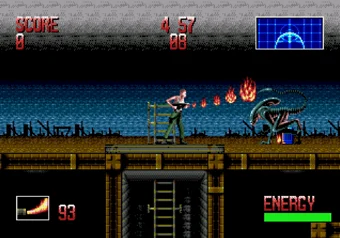

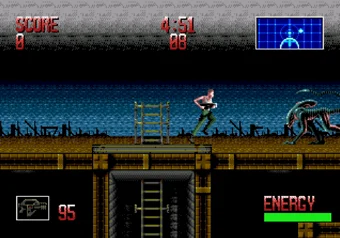
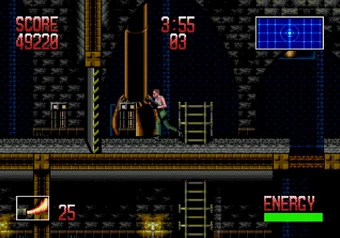
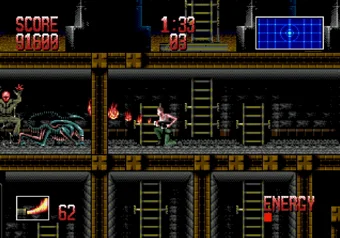
🎮 Gameplay and objectives
Alien 3 on SEGA Genesis/Mega Drive plays as a side-scrolling action game, but it doesn't feel like a straight run from left to right. Levels are built more like closed areas with multiple rooms, corridors, and doors, so you're constantly moving back and forth instead of just pushing forward.
Your main goal on each level is simple on paper: find and rescue a required number of prisoners. They're scattered across the map, often behind doors or tucked away in side rooms. Once you reach them, they're counted immediately, so there's no need to escort anyone. The challenge comes from actually locating them all.
There's also a strict timer running in the background. You don't have the luxury to check every corner at a relaxed pace. If you take a wrong turn or spend too long fighting, it starts to matter. You begin to second-guess your route, wondering if you missed a room somewhere earlier.
The exit only opens after you've rescued enough prisoners, so the whole level turns into a balance between searching and surviving. You're not just clearing enemies - you're trying to stay efficient, keep moving, and avoid wasting time on dead ends.
🧭 Exploration, routes and time pressure
At first, the levels can feel a bit confusing. You move left and right, open doors, go down corridors - and pretty quickly it stops being obvious where you've already been. There's no clear path pointing you forward, so you're constantly deciding where to go next. Some rooms lead to nothing useful. You check them anyway. Others finally give you what you were looking for, but by that point you've already spent time you probably didn't have.
That's where the timer really starts to matter. It's always there, and after a while you stop ignoring it. You clear a section, move on, then suddenly catch yourself thinking - did I miss something back there?
The game never really explains how to deal with this. You just figure it out after a few failed runs. You start remembering layouts, cutting unnecessary fights, moving a bit more carefully. Not slower - just smarter.
🔫 Weapons and combat
Ripley starts with proper firepower, and you feel it right away. The flamethrower is probably the most reliable weapon - wide range, constant damage, and perfect when aliens get too close. You also get access to the pulse rifle, which works better at a distance, and weapons like grenades and rockets that help clear tight spaces quickly.
The problem is that none of this lasts forever. Ammo runs out, and when it does, you're forced to switch or play more carefully. You can't just rely on one weapon the whole level.
Aliens keep showing up while you're moving through rooms, opening doors, or trying to figure out your route. If you slow down too much, they start stacking up from both sides. So you end up fighting on the move most of the time - just enough to stay in control and keep going.
🎬 Based on the movie, but not the same
Alien 3 on Genesis uses the same setting as the film - a prison colony with Ripley trapped inside - but almost everything else is handled differently. In the movie, she has no weapons and spends most of the time trying to survive. Here, you're armed from the start and constantly pushing forward, clearing rooms and dealing with enemies.
The game doesn't follow the film scene by scene. Instead, it builds its own structure around levels, objectives, and a timer. It takes the idea of Alien 3 and turns it into a fast-paced action game, where movement and efficiency matter more than staying hidden or avoiding danger.
🕹 Playing Alien 3 today
It still feels surprisingly tense. Not in a slow, horror way, but in how quickly things can go wrong if you lose track of what you're doing. The timer, the layout, the constant interruptions - it all adds up.
Levels are short enough that you can jump in for a quick run, mess something up, and try again without overthinking it. That loop still works.
And since you can play it online right on this page, it's easy to just start and see how it feels without setting anything up.