
Reading the isometric camera
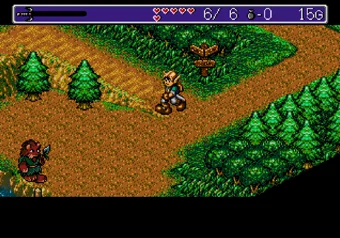
Nobody warns you about this upfront: Nigel only ever faces the four diagonal corners of the screen. He can't look straight ahead. So the direction keys lie to you. Tap or on its own and he drifts toward the top of the screen; or pushes him toward the bottom. You move with real intent only by holding two directions together. Treat the diagonals as your actual controls and half the frustration disappears.
Landing jumps you can't quite see
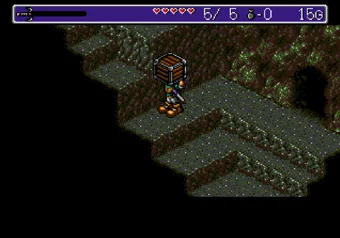
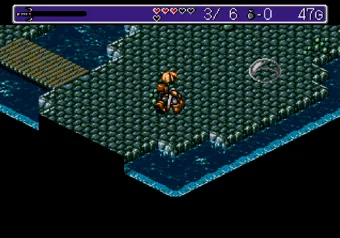
Jumping with Space is where the tilted view turns cruel. The game deliberately blurs how far off a platform sits, so a leap that looks perfect misses by a sliver of depth. Two habits save runs. Square up the diagonal before you commit, and when a gap looks ambiguous, edge right up to the lip first so you can read which tier the next platform is on. If a mushy keyboard or soft analog stick keeps betraying you, switch to firm directional taps. Landstalker rewards deliberate input; rushing a jump only drops Nigel down a tier.
Why grinding monsters never makes you stronger
Landstalker has no experience bar. You can clear every gnome in the Greenmaze and Nigel won't gain a point. Enemies just drop gold and Eke-Eke. Your one real stat is hit points, and you start the adventure on a laughable four hearts. The only way to raise that ceiling is Life Stock, and each one adds a permanent heart. Most towns sell exactly one and flatly refuse a second, so you can't buy your way to a big health bar. The rest hide in chests you'll walk past unless you check every dead end. The exception is Kazalt, the hidden late-game town, where Life Stock is unlimited at 1200 gold apiece — the place all that farmed gold finally pays off.
Staying alive between statues
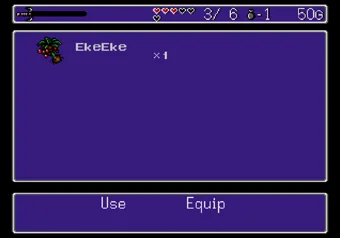
A Statue of the Goddess refills every heart for free, so treat each one as a checkpoint. Eke-Eke restore half your hearts and you can hold nine, and here's the quiet lifesaver: die with even one in the bag and Friday revives you where you fell. Dahl heals fully but won't trigger on death. The Healing Boots give back a sliver of health with every step. Stock Eke-Eke before any dungeon you haven't mapped. They're cheap, and Friday's auto-revive has saved more runs than any sword.
The gear worth going out of your way for
Swords
Your Broadsword is a plain poker with no special move. Everything better hits harder and, once fully charged, throws an element. The Magic Sword adds fire and comes free from a retired soldier, Kato, on a side road between Gumi and Mercator, so grab it early. The Thunder Sword (lightning) is your reward for freeing Verla, sitting in the town well. The Sword of Ice, found in the Lake Shrine, is the sleeper pick: its charged hit travels across the screen, letting you kill from range. The Gaia Sword tops them all, and a full charge sets off an earthquake that hits every enemy on screen at once. Better weapons sit further right on the equip menu, so you can always tell at a glance which one is your strongest.
Armour and boots
Buy the Steel Breast the moment you can scrape together 480 gold in Mercator. Doubling your defence that early trivialises a big chunk of the midgame. The Chrome and Shell breasts are upgrades tucked into the Verla Mines and the Lake Shrine, and the top-tier Hyper Armour hides behind a waterfall right after the brutal Spinner fight. Boots are quieter but matter: Fire Boots let you walk on flame (in a Massan cave you can only reach once you have Axe Magic), Iron Boots shrug off spikes, and the Snow Spikes are non-negotiable since you physically can't cross the final ice to finish the game without them.
Rings
Rings decide how fast your sword recharges, which turns those elemental specials from an occasional treat into a steady rhythm. The Saturn Stone doubles the rate and drops from the optional witch's quest; the Venus Stone triples it and waits deep in King Nole's Palace. If you'd rather not wait on a charge before a boss, a Golden Statue keeps the blade fully powered for a short stretch even without a ring.
The bosses that need a trick, not a bigger sword
A handful of fights in Landstalker don't care how strong your sword is. They test whether you've spotted the gimmick. Bang your head against them the normal way and they feel unfair; find the tell and they fold in seconds.
The Shadow Mummy
Waiting at the end of the Crypt's tenth riddle, "Aside the Shadow", this one wrecks first-timers. Hitting the mummy itself does nothing at all. Its shadow on the floor is the real target, so aim there and it dies. The riddle's name was the whole hint.
Zak
Zak looks intimidating and hits hard, yet he's almost embarrassing once you stop trading blows. Walk away from his swings so they whiff, then turn and strike while he recovers. Keep circling and don't get greedy, and he'll never land a clean hit. Beat him and he hands over Gola's Eye before he leaves.
Gola, the Dragon God
The final boss opens by burning the treacherous Duke alive, then turns on Nigel. Gola hits like a truck and one of its attacks stuns you outright, so patience is the whole game here. Only swing when the dragon lowers its head; that's your one safe window. Stay clear the rest of the time, and bring a couple of Golden Statues to keep your sword charged so the fight runs a lot shorter.
What to do when a door won't budge
Landstalker locks you in constantly, and a door only stays shut for three reasons. A key opens it, and keys come only from chests, never shops. Or the room wants every enemy dead before it lets you out. Or a switch controls it somewhere, sometimes one you trigger indirectly by shoving a block or landing a jump on it. When you're stuck, run that list before assuming the game has glitched.
One more rule worth burning in: every puzzle resets the instant you step out of the room and back. Wedge a block into an unwinnable spot and you don't reload a save, you just walk out and back in for a clean board. That reset is your friend in the Crypt too, a ten-riddle dungeon where a wrong answer can strand you until you leave and re-enter.
Keep those three fixes handy: a key, a cleared room, a hidden switch. Together they turn most of the game's walls back into doors, and that's the difference between wandering in circles and actually reaching King Nole's labyrinth. It's a run worth making with quick-saves on when you play it online.