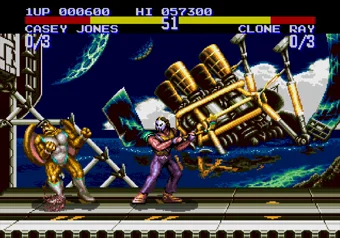
Grab loops, and why the CPU folds you without them
Grabs cannot be blocked. That rule sounds ordinary until you notice what it does to a knocked-down opponent: they have to stand up, and standing up takes time you can steal.
Watch the get-up animation once and you'll see two parts. The character rises, then makes a quick hop, and only after that hop can they act. Hold toward them and press +K or +L while close, and input it just before the hop. They get grabbed before they can move, they go down again, and you do it once more. Most of the cast can keep this going, and nobody needs the corner for it.
Who loops well and who doesn't
Leonardo's Pummel Grab throws the opponent straight up, which makes the timing generous: hold forward and grab again the moment they land. Raphael's works the same way. April's Suplex leaves her close enough to walk up and re-grab, and that one throw is why a reporter with mediocre normals beats characters carrying swords.
Ray Fillet's Strangle Hold and Sisyphus' Bug Hug run on fixed animations, so nobody escapes them early by mashing directions. Leonardo's and Raphael's grabs can be shortened that way, which stops mattering once the loop is running. Casey Jones only catches up if his Speed is set to 8. Michelangelo throws too far and has to chase with Flying Tackle, the fussiest loop here. Donatello's Bo Toss sends them so far that only the corner gives him a loop at all, and that single missing tool is most of what's wrong with him.
You can beat difficulty 8 without ever doing this. It's just a bleak way to spend an evening.
Special moves: the four Turtles
Every command below assumes your character faces right. Facing left, swap Left and Right. Each special works with either attack button, and the choice matters more than you'd expect: L versions travel faster and further, K versions come out slower and stay closer.
The normals work the same way. Hold toward the opponent while you attack and you get the heavy version of that punch or kick, and those heavies are where the damage is. Crouching heavies need the diagonal: hold down and forward together, then attack.
Leonardo
- Ground Swell: ,+,+K — near-instant startup, ripples along the floor
- Jumping Stud: ,++K — invincible anti-air, awkward motion, expect Ground Swell by accident
- Rolling Cutter: ,+,+K — also works in the air, and becomes unblockable if you roll through a downed opponent so it hits them from behind as they rise
Raphael
- Sai Slash: ,+,+K — slow projectile he can walk behind at full screen
- Power Drill: ,+,+K — air OK; hold forward and mash L afterwards for a jumping kick that can land unblockable
- Spark Plug: Hold,+K — an overhead on the way down, so it has to be stand-blocked
Donatello
- Vacuum Wave: Holdfor 2 seconds,+K — tall projectile, and he recovers almost immediately after firing
- Roto Bō: Holdfor 2 seconds,+K — his answer to jump-ins
- Blur Attack: +K — save it for finishing a low-health opponent, since it leaves him open even when it connects
Michelangelo
- Hurricane: ,+,,+,+K — instant, barely any recovery
- Chopper Chuker: ,+,,++K — good anti-air, dead while Hurricane is on screen
- Flying Tackle: Holdfor 2 seconds,+K — no recovery whatsoever, safe on block, also blocked by an active Hurricane
Two of Michelangelo's three specials shut off while his tornado is still travelling, which is a strange thing to discover mid-match. Throw the Hurricane and you've temporarily traded your anti-air for it.
Grabs go on +K and +L up close. Leonardo and Raphael get the Pummel Grab on +K, the launching throw the loop is built on. Donatello's Bo Toss and Michelangelo's Nunchaku Toss both sit on +L and both send the opponent much too far away.
Special moves: Casey, April, Ray and Sisyphus
The four allies are where the roster gets strange. One of them is the strongest character in the game, one of them wins entire matches with a single move, and one of them spits goo.
Casey Jones
- Stick Lariat: ,+,+K — invincible throughout, steerable left and right while spinning, and it repeats twice with L
- The Long Bomb: +Space — beeps, then explodes on whoever is standing there, Casey included
- Rebounder: ,+,,+,+K — reflects incoming projectiles, but not Krang's missiles or Karai's javelin
April O'Neil
- Back Drive Elbow: ,+,+K — instant, knocks down, doubles as an anti-air, clears projectiles at the right range, has to be stand-blocked
- Ninja Claw: mash K — multiple slashes she's locked into until they finish
- Ninja Attack: Hold,+K — far too slow, you will get swatted out of the air, avoid
Ray Fillet
- Sonic Wave: ,+,,+,+K — solid, unremarkable projectile
- Manta Press: Holdfor 2 seconds,+K — depending on range he lands behind them, which is how his cross-ups happen
- Head Butt: Holdfor 2 seconds,+K — delay the up input to trigger it barely off the ground and it becomes an instant overhead
Sisyphus
- Beetle Juice: ,+,+K — long startup, quick recovery once the goo is out
- Beetle Flash: mash K — a flurry of horn thrusts he can't cancel out of
- Hover Horn: Holdfor 2 seconds,+K — a low slide that has to be blocked several times over
Two of those specials shut down while Beetle Juice is still on screen, so Sisyphus spends a lot of matches waiting for his own projectile to leave. What he gets in exchange is unique: he's the only one of the eight who can block another special during any of his own special animations.
Ray's Strangle Hold and Sisyphus' Bug Hug both live on +L, as does April's Suplex. Casey's Stick Slam is on +K. And a warning worth taking seriously when you're playing online and feeling clever: the Long Bomb damages Casey exactly as happily as it damages the other guy. Drop it, then Stick Lariat through the blast to come out clean.
Power and Speed: the two sliders that decide the match before it starts
After you pick a character the game asks you to set Power and Speed, each from 1 to 8, each adjusted separately. Cranking both to 8 is the obvious move and it's wrong twice over.
Power raises the damage of your normals and most specials, and keeps your normals active longer. It also slows the animation of your standing and crouching normals and your throws. At Power 8 your heavy attacks land like trucks and arrive like postcards.
Speed does what it says: faster forward walk, faster jumps, faster animation on certain specials, and a quicker drop out of airborne moves.
What should I set them to?
Against the CPU, leave both at 4. Your settings get copied onto the computer, so Power 8 hands it the same damage it just handed you, and Speed 8 makes its jumps arrive faster than you can react to them. Against another person there's no reason to play below Speed 8, since only you get it.
Two settings are worth breaking that rule for. Casey Jones can't complete his grab loop below Speed 8. Sisyphus wants Power dropped to 1, of all things, because it makes his crouching heavy punch fast enough to use on reaction, which is what you need against April's elbow.
Desperation Move commands
These only exist while the red section of your life bar is flashing, and every one of them runs through the Taunt button. That last detail is the trap. Miss the motion and the game reads your input as a plain taunt, so your character stops to gloat with a sliver of health left and the opponent walks in for free.
- Leonardo: ,+,,++Space
- Raphael: ,+,,++Space
- Donatello: ,+,+Space
- Michelangelo: ,+,+Space
- Casey Jones: +Space — close range only
- April O'Neil: ,+,,+,+Space — close range only
- Ray Fillet: ,+,,++Space
- Sisyphus: ,+,,++Space
Nobody has found one for Krang or Karai — no command works and the CPU never shows one, which is one of the few mercies the last two fights offer.
Which ones are worth the risk?
Ray's sound wave, because it dizzies on one hit and still hurts through a block. Michelangelo's screen-tall tornado for the same reason, with the caveat that any ordinary projectile cancels it. Leonardo's roll is unblockable and reaches opponents who are still flat on the floor, and Raphael's does the same trick with a nastier payoff: land it from behind, or while his Sai Slash is about to connect, and the entire health bar disappears. Back-throw someone and hit them with it before they stand and the round just ends.
Half a life bar is the usual return, sometimes far more. Against another human these rarely decide anything, because you need to be nearly dead in a game where one knockdown can already finish you. Against the CPU they're worth every attempt.
Stop looking for combos. There aren't any.
Land a hit and the opponent is untouchable until they finish recovering, at which point they can block again. Nothing links into anything. Sisyphus' Hover Horn hitting twice is about as close as the engine gets to a combo, and that's a quirk rather than a system. If you arrived from Street Fighter II expecting to convert one poke into four, you'll spend the first match confused about why your second attack keeps whiffing on someone standing right in front of you.
What replaces combos is single hits that have to earn their place. Specials chip through a block. Many specials also let you block other specials mid-animation, provided the incoming attack doesn't hit low.
Since every exchange comes down to one guess at a time, block low and stay there. Hold back to block standing, down-back to block crouching, and note that plenty of standing normals hit low while jump attacks can only be blocked standing. Grabs and unblockables ignore all of it: jump out, or counter-attack immediately and hope yours starts first.
How does dizzy actually work?
Repeated clean hits build toward a dazed state, stars and all, but the rules are narrower than they look. You cannot stun an airborne opponent no matter what you hit them with. Throws raise the stun counter and never trigger it, so no amount of grabbing dizzies anybody. It only happens on a grounded hit, and the sweet spot is catching someone the instant they land from a jump or just before they commit to an attack.
Then the part that costs people rounds: a dizzy opponent can still block. Throw a projectile at those spinning stars and they'll block it and snap straight out of the daze. Walk up and grab instead.