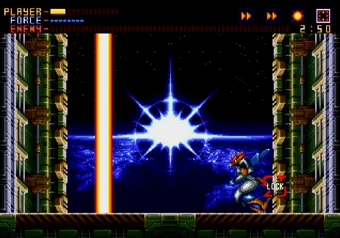
The moves that are easy to miss
The three-button layout looks almost insultingly simple: jump, shoot, and a ring to swap weapons. Everything that actually keeps Epsilon-Eagle alive is buried in combinations that are easy to overlook.
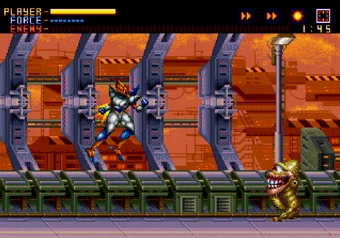
Zero Teleport is the one to learn first. Press +Space and you dash across the screen, untouchable until the moment you land. It crosses gaps, but its real job is blinking straight through a boss to come out behind it, where most of them have no idea how to aim.
Tap jump a second time in mid-air to hover on your jets. You get one hover per jump, and you can teleport straight out of it. It barely matters on Supereasy, where pits have platforms strung across them. On Superhard those platforms are gone, and hovering is the only thing between you and a slow leak of life as you sink.
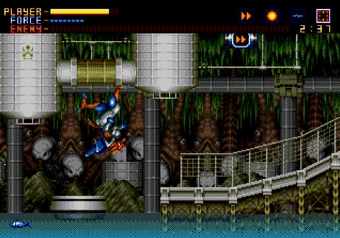
Jump into a ceiling and you cling to it upside down, still free to move and fire. Handy for raining shots onto bosses that camp the floor, but up and down swap while you are up there. Press to teleport off the ceiling. Press out of habit and you fire yourself deeper into it.
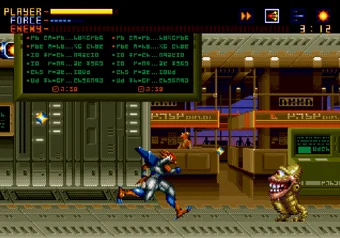
One more that is easy to miss: +L flips your firing mode. Fixed mode roots you in place but lets you aim in eight directions instantly. Free mode lets you walk and shoot, locked to one direction. Switch any time you like. Screen-filling bullet bosses want you moving; a boss with one tiny weak point wants you planted and aiming.
The firebird and the catch
Two techniques carry the whole game, and both run on the same resource you are trying to protect: your own life.
The first turns Zero Teleport into a weapon. Dash with +Space while your health bar is full and Epsilon becomes a screaming firebird that shreds anything in its path, often carving away a huge slice of a boss before it can react. The catch is the price: the dash drains 30 of your own life on Supereasy and 50 on Superhard, every time. So the firebird only exists at full health, which means you spend the fight trying to climb back up to it for one more devastating pass.
That is where the second technique comes in. Double-tap fire and Epsilon throws up a small energy ball in front of him for a split second. Catch an enemy shot in it and the shot converts into health. Catch the right projectiles and you can refill the exact life the firebird just cost you, then dash again. Learning which boss attacks are safe to swallow is most of the skill ceiling here, and it is what separates surviving a fight from dismantling it.
Choosing your four weapons before you start
The most important decision you make happens before the action does. There are six Force weapons, but you only carry four into the game, and you lock that choice in at the start. Pick badly and you will feel it twenty stages later against a boss your loadout simply cannot hurt fast enough.
Each weapon has its own ammo bar that only refills while it sits idle in your ring, so you end up swapping guns constantly during a fight. Buster Force is the reliable straight-ahead machine gun for clearing rooms but tends to get deflected by bosses. Flame Force melts boss health faster than anything else, with two ugly downsides: pitiful range and an ammo bar that empties almost as fast as it does damage. Homing Force asks nothing of your aim and slips through enemy defenses, which makes it the lazy-but-effective answer to half the boss roster. Lancer Force punches hard but starts with only about six shots, so it rewards picking its moment.
There is one option that is easy to overlook: you can fill a slot with the same weapon twice. Two Flame Forces means double the ammo before you run dry, which can be the difference in a long fight. A loadout that holds up: one all-purpose gun, one no-aim option, and a doubled-up heavy hitter for bosses. There is no single right answer, and figuring out your own loadout is half the reason the game is worth playing online more than once.
Level passwords for every stage
The passwords are four digits, and each one drops you in at the start of a stage so you never have to grind back through the boss rush from scratch. One catch worth knowing before you rely on them: they only work on Supereasy. Superhard has no passwords and no continues at all, so a death there sends you back to the very beginning. If you just want to see how the game ends, punch in 5289 and you are standing in front of Z-Leo, the final boss.
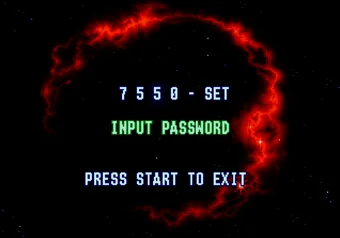
Four-digit stage passwords
- Stage 1: 1985
- Stage 2: 3698
- Stage 3: 0257
- Stage 4: 3745
- Stage 5: 7551
- Stage 6: 8790
- Stage 7: 5196
- Stage 8: 4569
- Stage 9: 8091
- Stage 10: 8316
- Stage 11: 6402
- Stage 12: 9874
- Stage 13: 1930
- Stage 14: 2623
- Stage 15: 6385
- Stage 16: 7749
- Stage 17: 3278
- Stage 18: 1039
- Stage 19: 9002
- Stage 20: 2878
- Stage 21: 3894
- Stage 22: 4913
- Stage 23: 2852
- Stage 24: 7406
- Stage 25: 5289
How to survive a boss every thirty seconds
The most useful thing the game does is refuse to hide its math. It shows exactly how much damage each shot deals and how resistant every part of a boss is to the weapon you currently have out. You are never guessing where the weak point is. If the numbers barely move, you are hitting armor, and the part that actually bleeds is the one to keep shooting.
That feeds straight into your weapon ring. Plenty of bosses have pieces that swat away straight fire, like a crab's claws or Xi-Tiger's raised arms. Homing Force ignores all of it and curves past the guard to the body underneath. If your shots are pinging off and the damage readout sits at zero, stop and switch. You are not underpowered, you are aimed at the wrong piece.
Position handles most of the rest. A surprising number of bosses simply cannot reach the ceiling, so cling up there, chip away in safety, and drop only to land a full-health firebird pass before climbing back out of range. And the game never lets a single hit take you from healthy to dead: a blow that should end the run leaves you alive at one point of life instead, buying a sliver of a second to teleport clear. It is a cushion, not a plan. At one point of health, the next thing that touches you is fatal.