Attacking moves the help screens skip
The game explains dash, shot, pass, high ball and the keeper's dives, then leaves you with six buttons and no word on feints or one-twos. The factory layout on the button screen before each match is A to dash, B to pass, C for a high ball and Z to shoot.
Feints and the heel lift
Hold a direction and A to sprint, but ease off now and then, because a player who sprints too long runs out of stamina. Tapping A several times instead of holding it turns the sprint into a feint. Change direction in the middle of a feint, hold the new one and keep tapping, and the player is back in a dash. Learn that loop before anything else on this page.
The heel lift is fussier. While dashing, let go of both the direction and A, then press C the moment the player slows down and is about to stop. Training's Free Mode lets you practise feints and lifts on the whole field, and this one needs the practice.
How do you play a one-two or a through ball?
For a one-two, hold A+B toward the teammate you want to pass to, then steer the return ball with a direction. Because you aim the second pass yourself, it's the most useful pass in the game once it clicks.
- Through pass: hold Y+B, keeping B down a moment before releasing for a longer ball.
- Long pass: C, held for extra distance.
- Cross: C with a direction, aimed into the penalty box.
Shooting past the keepers
The keepers are very good, and your first goals will take a while. Z shoots from the opponent's half, and the longer you hold it, the higher the ball goes, so a quick tap keeps it low. For a lob, hold the direction pointing back toward your own goal while dashing and press Z. When the ball is in the air, Z gives a header or a bicycle kick depending on where the player is, and B or C heads it on to a teammate. Standing still, C flicks the ball up high for exactly that.
Shots from certain exact spots on the screen go in every time, some from as far out as the middle of the pitch, and certain long balls beat the keeper to the jump just as reliably. The RetroGameTalk reviewer calls this the "Pixel Perfect Shot" and remembers matches with goals in the tens. Where the spots are, you'll have to find yourself. If that sounds like too much work, Open Game lets you set the keepers' skill level before kick-off, anywhere from a klutz to a Lev Yashin.
Free kicks, corners and penalties
Ten of the twelve scenarios open with a free kick or a corner, so if you're playing Scenario mode, this is the section to read twice.
Free kicks
Press A to scroll the camera, then A again to move your players into place with a direction. Z shoots and C plays a long pass, and holding a direction right after either one bends the ball. B plays it short.
Corners
The camera works the same way, A and then A again. Z goes for goal and C plays it long, both bendable with a direction held afterwards, and B is the short option. Y changes the side and the kicking foot.
Throw-ins are on B or C; hold the button before letting go to throw further. Scenario 5 starts with one.
How do penalties work?
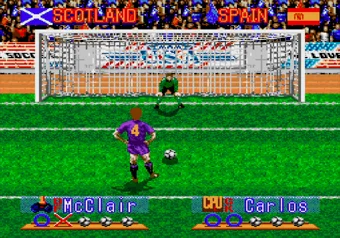
Penalty Kicks mode is five each, then sudden death if it's still level. Before it starts, you choose the order your players take them in. B shoots low and C shoots high, and the direction you hold picks the side. In goal it's the same pair, B to save low and C to jump high, with the direction choosing where the keeper goes.
Defending and the goalkeeper
Tackles live on the pass buttons: B for a standing tackle, C for a slide. Z+C together barges the ball carrier with a shoulder charge. Y hands control to another of your players, and once you win the ball in your own half, Z with a direction clears it. If matches keep ending in cards, you can edit the rules so the referee shows none, or ignores most fouls altogether.
The pre-match settings also decide how switching works. AUTO CHANGE moves you to whoever is best placed. MANUAL CHANGE leaves it to you, and its TYPE setting decides where the cursor lands. B TYPE picks between the two defenders closest to the ball, which makes it the defender's choice.
Should you control the goalkeeper yourself?
No. The button screen before every match has a KEEPER setting that starts on AUTO, and it's best left there. On SEMI-AUTO or MANUAL the dives are yours to time, C to jump high and B to dive low, and that's a lot to handle on top of running the defence.
Scenario mode: how many goals each one needs
Each scenario drops you into the closing minutes of a match, with your side behind or level and a restart to take, and you have to win before the clock runs out. The mode is open from the start. The times below are what's left on the clock when you take over.
One goal to win
- 4. Germany 0-0 Italy, 0:56, Germany free kick. The briefing wants the winner from this very kick.
- 5. Turkey 1-1 Sweden, 0:49, Turkey throw-in.
- 6. Belgium 1-1 Spain, 0:42, Belgium free kick. The shortest clock in this group.
- 8. Scotland 0-0 Russia, 1:24, Scotland goal kick. You start from your own end, but 1:24 is time enough to build an attack.
- 10. Argentina 2-2 Brazil, 0:49, Argentina corner. The briefing warns that Brazil "seem like they can score from anywhere", so don't lose the ball chasing the winner.
Two goals to win
- 1. Italy 1-2 Croatia, 1:14, Italy corner.
- 2. Germany 2-3 Bulgaria, 1:02, Germany free kick.
- 7. Romania 0-1 Poland, 1:43, Romania free kick. No other two-goal scenario gives you this long, so the briefing's "plenty of time" is fair.
- 9. Portugal 0-1 Ireland, 0:38, Portugal free kick. Two goals in 38 seconds makes this the hardest of the twelve on paper, and a shot straight from the free kick is worth trying.
Three goals to win
- 3. England 1-3 Brazil, 1:54, England corner. The longest clock in the mode, and you'll need all of it.
- 11. Holland 1-3 Czech Rep., 1:38, Holland free kick. The same job as England's, with 16 seconds less.
How do you beat the England vs Japan scenario?
Scenario 12 gives England a corner at 1-1 with 0:02 on the clock, and the briefing is clear that a draw is as good as a loss. Two seconds leaves room for the corner and not much else, so the goal has to come from it. Curl it straight in with Z and a held direction, or play it long with C and meet the ball with Z in the air for a header. Corners are on the Free Mode practice list in Training, so try both there first.
Cheats, a password and saving
Button codes and a password
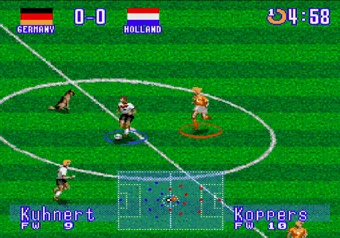
Enter the codes on the main menu. A dog barks when one goes in, which fits, given the third code on the list.
Main menu codes
- All 8 stars: UpDownLeftALeftBRightA
- Edit team and player attributes: LeftRightDownRightLeftBAB
- Turn the referee into a dog: RightUpBLeftUpADownA
- View the ending and credits: DownUpALeftABRightLeftRightLeftBDownUpRightUpB
Password
- Argentina vs World All Stars, the final: P$÷b+SJ
Passwords or the Save button?
The game has no save of its own, only passwords, and they mix in symbols. On the password screen, pick a symbol with the direction and type it with C; B erases and Y moves the text cursor. When you play online here, the site's Save button is simpler: it keeps one save per game in your browser, each new save replaces the last, and the Load button shows when you made it. Saves stay on that browser and device, and clearing the site's data wipes them. That matters most in the World Series, where 36 teams play each other home and away, which is 70 matches for yours.