
What each of the three buttons actually does
Offense: one button, two different shots
Tap Space for a wrist shot, hold it for a slap shot. That one distinction decides most games. The wrist shot travels slower but goes where you point it, so it belongs anywhere near the crease. The slap shot is faster and sloppier, which is why it scores from the blue line and embarrasses you from the circle. Shots aim themselves at the net, but holding left or right while you shoot tucks the puck into a corner, and holding toward or away from the net puts it high or low. Passing is K, aimed by the direction you are holding. Press it with nothing held and the puck goes wherever your skater happens to be facing, which is how most interceptions begin. L chips a flip pass into the air, harder to read and harder to steal. For a one-timer, press Space just before the pass reaches your man.
Defense: poke, check, or hook?
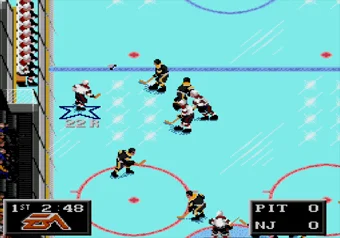
K switches you to whoever is closest to the puck, and the same button becomes a poke check once you are right on top of the carrier, either lifting the puck off him or tripping him in the attempt. Space is the body check, and it hits harder the faster you are already moving, so a check thrown from a standing start barely inconveniences anyone. Hold Space while skating without the puck for a burst of speed. L hooks the stick, which slows the carrier down without hitting him, and it is what you reach for when you are a step behind and know you will never catch up. One rule worth burning into muscle memory: never touch a man on a breakaway. The game plays a ding the moment a breakaway starts, and fouling him there hands the other team a penalty shot with nobody on the ice but your goalie.
Goalie: is manual control worth it?
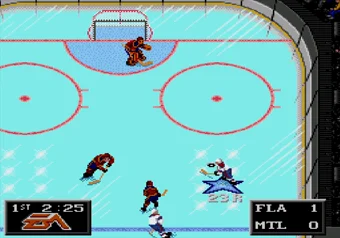
Hold K until a star outline appears under the goalie and he is yours. He shuffles a short distance around the net, L plus a direction makes him dive, and Space drops him onto the puck for a save. With the puck he clears it using L or passes with K, and this is exactly where manual control turns into a highlight for the other team. An intercepted goalie pass is a goal against roughly as fast as you can read this sentence. Even on automatic control the goalie is yours whenever he is holding the puck, and if you sit on it for a few seconds the referee blows the play dead for a face-off in your own end.
Goals that go in almost every time
The wraparound
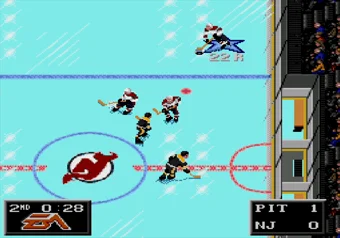
Take the puck behind the net, come around the post and stuff it in before the goalie slides over. He gets stuck back there often enough that this is the first thing to try when the computer has shut you out for two periods.
Why does cutting across the slot always work?
Stop dead on one side of the ice, dart across the front of the crease, and shoot into whatever the goalie leaves open behind you. The goalie commits to the side you started on, and the shot arrives before he gets all the way back across. Brian Boyle, who ended up playing the sport for a living, still describes it as a glitch. Against the computer it is close to automatic, which is why house rules against it exist at all: George Parros summed his up as "no using the default move". The computer never learns to stop it. A human on manual goalie control will.
One-timers from the corner
Patrice Bergeron, asked years later what he did in this game, answered "I'd go for the one-timer in the slot. That's the move." Work the puck to the boards or behind the net, pass out to a man in the slot, and hit shoot before he actually takes possession. Everything moves fast enough that mashing the shoot button after the pass lands about as many one-timers as clean timing does.
Breakaways
Break to one side, snap back across, quick wrist shot. With a right-handed shooter go left first and finish right. If the goalie is already leaning, start toward his strong side and shoot at the side he abandoned.
The weight bug: why small players flatten Lindros
Collision math in this game runs backwards: on a body check the lighter skater wins instead of the heavier one. Roenick is listed at 6-foot, 172 pounds in the game. Eric Lindros is 6-5, 236. Mario Lemieux is 6-4, 220. The small guy runs both of them over. An EA Sports programmer has confirmed it, and the error came in from NHLPA Hockey '93.
What that means on the ice: your quickest, lightest forward is also your best hitter, and hauling a heavyweight defenseman across the zone to deliver the big check is mostly wasted effort. Checks land harder the faster you are already skating, so a light winger at full speed is the worst thing anyone can collide with. Land one hard enough and the victim is gone for the rest of the period. Mark Lesser, who programmed the game, argues that ratings, the angle of the hit and where everyone is standing decide more than weight does, so treat a light forward at full speed as an edge rather than a guarantee.
Seven lines and exactly one timeout
Leave line changes on and your skaters tire quickly, so the roster is split into seven lines. Two scoring lines, Sc1 and Sc2, hold the fast players with the best puck control, and Sc1 starts every period. Two power play lines, Pw1 and Pw2, come out when the other team is short. Two penalty killing lines, Pk1 and Pk2, carry four skaters each with a single winger, because you are the one who is short. The checking line, Chk, collects the biggest and slowest bodies on the team. Given how collisions actually resolve here, that line is better at protecting a lead than at hurting anybody.
The change menu appears on its own before a face-off and when a power play ends. You can also force it by holding L while carrying the puck, which throws a flip pass at the same time, since it is the same button. Pick a line by pressing L, K or Space for whichever slot it sits in, and read the bars beside each line name for how much is left in their legs. If you need a stoppage right now, cover the puck with the goalie.
The timeout restores every line on both teams to full, and each team gets one per game. Spend it right after you score when you need a second goal in a hurry. Switch line changes off and nobody tires at all, the whole team becomes one line, and the timeout stops doing anything.
Cheats and glitches
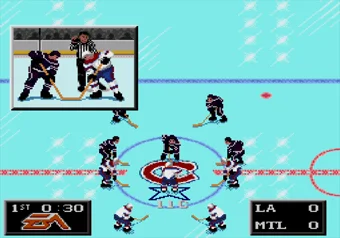
How do you get 30-second periods?
Press and hold L+Space immediately after starting the game, and keep both buttons down until the Edit Lines screen appears. The time box will read 0:30. Shortest legal period in the game is five minutes, so this is well outside the menu, and it turns a four-round playoff run into something you can finish over lunch. It is also the fastest way to drill the cross-slot move until it stops feeling like luck.
Healing an injured player
Lose someone to a hard check and he is out for the period, with a replacement dropped in automatically. Pause the game, choose TIMEOUT, and he comes back untouched. The catch is that each team gets one timeout per match, so a star who went down in the first period costs you the fresh legs you were saving for the third.
Which team should you pick?
Nine players are rated 90 or better and Mario Lemieux is the only 100 in the game. Ray Bourque sits at 99, Ed Belfour at 98, Alexander Mogilny at 96, Steve Yzerman at 95. Wayne Gretzky is 13th at 87, which catches out everyone who picks Los Angeles expecting a shortcut. Roenick's 89 only ties him for 11th with Doug Gilmour, so whatever makes him feel unstoppable is not living in that number.
Team ratings top out with Chicago at 78 and bottom out with the two expansion clubs that had not played a season yet, Florida at 51 and Anaheim at 52. Roenick is the whole reason for that old house rule about nobody being allowed to take the Blackhawks. Belfour at 98 in the same net just makes the argument shorter. Pittsburgh at 75 gets picked just as often, because Lemieux at 100 makes every other decision on the ice easier. The two All-Star squads outrate all of them and the game refuses to let you use them in either playoff mode.
Ron Barr's pre-game comparison marks who is hot and who is cold before the opening face-off, and a streak moves that player's performance by 10 to 30 percent either way, so the cold ones belong on the bench. The crowd meter in the pause menu does real work too: player stats shift with how loud the building gets. All of it runs online here, on the version people still bring to tournaments. Take Ottawa's 39-rated goalie against the All Star East if you want to see how ugly a scoreline can get.