Special stages: how to find Tails and Knuckles
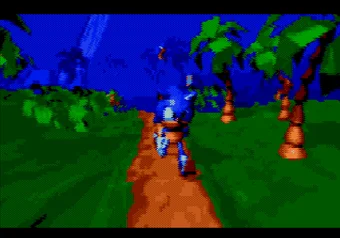
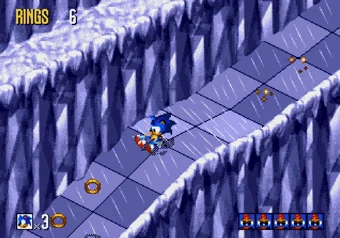
There are seven Special Stages, one per Chaos Emerald, and they're all accessed through the first five zones. Tails and Knuckles each show up multiple times across those zones, and finding them is the only way in. Stand next to either one with at least 50 rings; they absorb the rings and pull Sonic into the stage. Come up short and they just wait. The useful part: you can give a partial amount, leave the act, collect more rings elsewhere in the same act, and return; the total accumulates. What doesn't carry over is the helper's willingness. Each Tails or Knuckles will only transport you once per act. Come back afterward with a full stack of rings and all you get are bonus points. On Genesis/Mega Drive, the stage itself is a run down a long bridge scattered with rings and rolling bombs.
A few helpers worth tracking down specifically: Tails is behind a secret tunnel past the invincibility box in Green Grove Act 2. In Diamond Dust Act 1, Knuckles is down the left branch off the ice river, easy to miss if you're trying to move upstream quickly. Volcano Valley Act 1 hides Tails behind a wall that needs a Spin Dash to break; the wall is reached by spinning up an elevator first. Spring Stadium Act 2 has both Knuckles and Tails in the same hidden area in the upper right corner of the level.
Collecting all seven Emeralds unlocks The Final Fight, a separate boss encounter after Panic Puppet Zone that's only accessible if you have all seven. Without them, Eggman escapes with the Emeralds and that's the end. The bad ending is short and intentionally unsatisfying.
Shields and zone hazards
Three shield types show up in monitors throughout the game, and two of them change what Sonic can actually do rather than just absorbing a hit. The blue shield is the basic one: it takes a hit so Sonic doesn't scatter rings and Flickies. The yellow shield adds a downward stomp when you press jump mid-air, useful for hitting enemies you'd otherwise need to approach from the ground. The fire shield does the most: immunity to fire hazards and the ability to walk on lava.
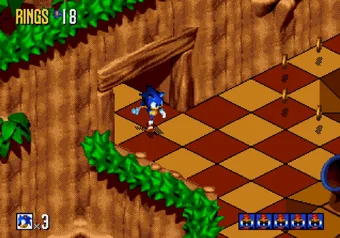
In Volcano Valley Act 1, the fire shield is hidden behind a breakable tile. The second tile from the top is the one with a hole behind it. It doesn't look different from the others. Find it and the fire gun pods lining the walls stop being a threat, and lava platforms that would drain rings on contact become safe ground. Act 1 plays completely differently with it — which you'll notice fast when playing online.
The fire shield also shows up in Rusty Ruin Act 2, where it blocks the fire hazards from the wall pods in that zone. Worth picking up there if you find the monitor, though Volcano Valley is where it actually changes the route. Diamond Dust Act 2 has a yellow shield hidden behind ice spikes near Tails, useful before attempting the Special Stage in that act, since the downward stomp gives a vertical attack option on ice where spin-dashing tends to send Sonic further than intended.
Cheat codes: level select and beyond
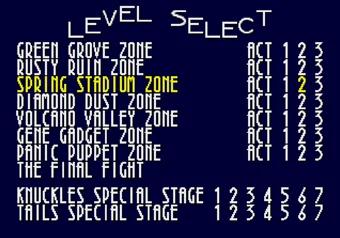
Level select
At the Press Start screen, enter LKKSpaceK, which spells "BARACUDA" on the controller buttons. This takes you to the main menu; selecting Start opens Level Select. Any zone, any act, immediately.
With Level Select active, pausing mid-level and pressing K skips to the next act. Inside a Special Stage, the same pause skip awards the Chaos Emerald for that stage outright. No need to complete the run. Combined with the BARACUDA code, you can collect all seven Emeralds from Level Select in a few minutes and go straight to The Final Fight.
There was a second way into Level Select that had nothing to do with button inputs. Jon Burton programmed an exception handler into the cartridge: if the game crashes, instead of freezing it routes to the Level Select screen. He did it to pass SEGA's approval process without restarting submission if something went wrong. The side effect is that physically wobbling or tapping the cartridge in a running Genesis/Mega Drive will usually trigger that same crash path and drop you into Level Select.
If you have Level Select and want to find the Konami Code easter egg, navigate to The Final Fight through Level Select, then enter LKEnter. It skips to the ending screen with Robotnik defeated.
Panic Puppet Zone boss: all three forms
The Act 3 boss in Panic Puppet has three distinct phases, and each one changes the attack pattern enough that what worked in the previous form will get you hit. In all three forms the target is the same: the blue ball at each shoulder. How you reach it changes completely.
Form 1: dropping arms
Each arm moves and then drops straight down. Stand in the shadow of an arm as it positions, then move away the instant it signals a drop. When the arm lands and the shoulder is exposed, jump and hit the blue ball. Repeat for both arms. This is the most forgiving phase: the timing is readable and the drop gives a clear opening.
Form 2: heat-seeking fire
The arms now fire heat-seeking projectiles instead of dropping. Stand directly under the shoulder of whichever arm is about to fire, wait until the instant it fires, then jump and hit. The heat-seeking nature of the projectile means moving away to dodge is worse than staying close; it will follow you. Jump immediately after the shot fires and you go through the opening before it can track. After the hit, move to the opposite shoulder and repeat.
Form 3: bouncing blue balls
The arms fire bouncing blue balls that accumulate on the field. The key is minimizing how many are in play at once: stand under the shoulder and jump the moment it starts firing, which hits the shoulder before the ball has time to bounce away. More balls in play means more to dodge while repositioning. After each hit, run to the opposite shoulder and repeat before the field gets cluttered.
The Final Fight: rings first, boss second
The Final Fight is only accessible after collecting all seven Chaos Emeralds, and it starts with a constraint that catches most players off guard: the only rings available are the ones scattered at the very beginning of the arena. There is no ring box mid-fight, no second chance to stock up. Grab everything before the boss engages.
Phase 1
The hands fire laser beams horizontally across the field. Dodge them and wait; the boss will move over the field and give you a window to jump and hit the main body directly.
Phase 2
Heat-seeking fire. Run to keep ahead of it. The boss passes over the field roughly three times before the opening appears; the hit window comes on that third pass.
Phase 3
The field narrows. The hands drop on a timer — move normally until the music gets frantic, then watch shadows. After the drop sequence, the hands slide horizontally across the field; jump over them. Hit the boss when it descends.
Phase 4
Missiles fall from above. Avoid the shadows. The hit window is brief — don't wait for a comfortable opening that won't come.
Phase 5
Bouncing blue balls fill the field. Stand in the left corner and only jump when one comes directly at you. The boss moves out after a cycle — hit it then, before the next round starts.
After Phase 5, all five phases repeat once more before the fight ends. The ring supply from the opening has to last the entire fight.